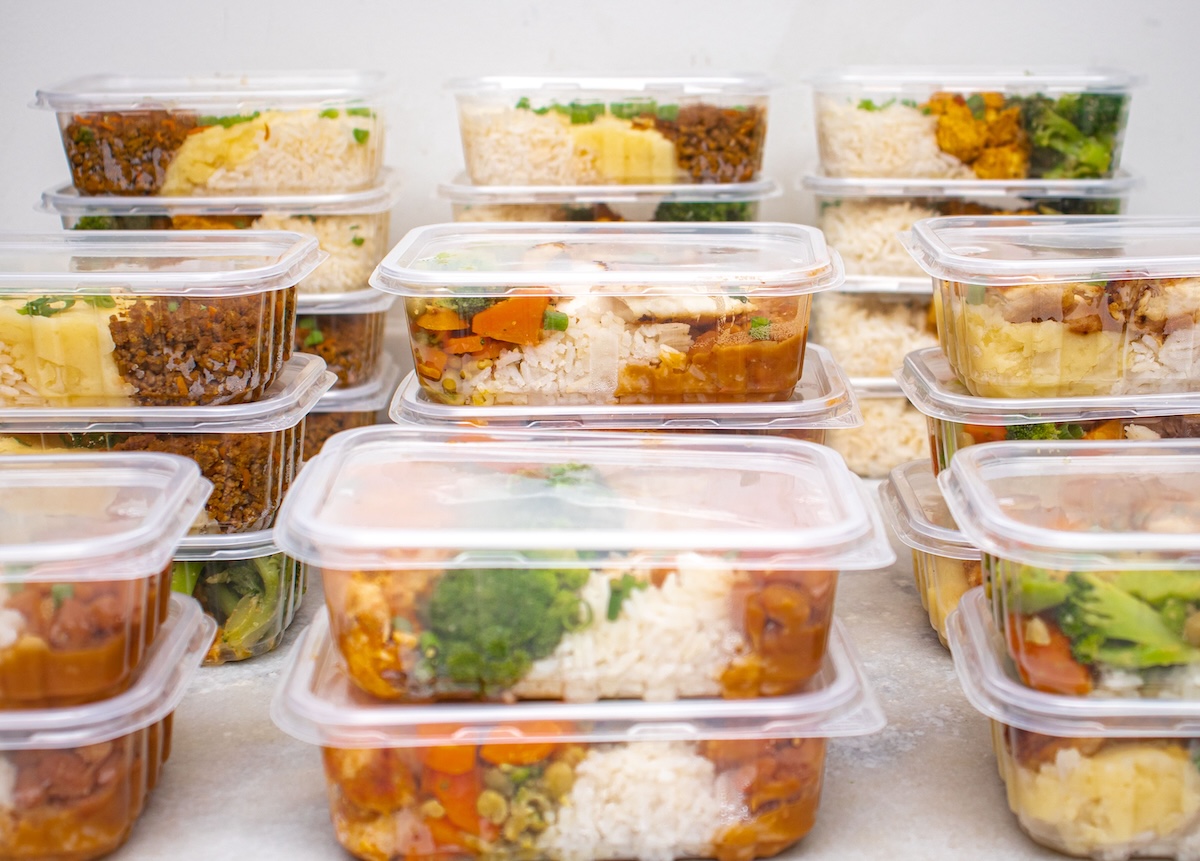
Sunday You is a great person. Sunday You has time, a clean kitchen, and a vision. Sunday You buys kale and meal preps to make the rest of the week sing.
Thursday You would like a word.
The real struggle with meal prep has nothing to do with discipline: You're asking a well-rested person on a slow afternoon to make multiple binding meal choices on behalf of a stranger—a tired, cranky stranger standing in front of an open fridge at 7:15 on a weeknight, scanning for anything they didn’t already eat yesterday. When push comes to shove, that cranky stranger will order fast-food delivery and blow up both their budget and their diet.
The fix isn't prepping harder. It's prepping in a way that leaves Thursday You some say in the matter. Here’s how to meal prep like a pro without sacrificing deliciousness.

Cook Family Style, Not Bento Box
Ask Chef Amanda Huang of Earth Made Kitchen, which offers professional meal prep services in New York City, what’s overrated in meal prep, and she goes straight at the trope of countless internet meal-prep videos: five identical containers, stacked in the fridge like a supply drop.
"You're stuck with the same foods over and over again, divided into these compartmentalized containers," she says. "Although foods can be different, there is still this boring pattern that happens, which may affect your mood."
Chef Huang favors family-style prepping. Cook a few things in bulk, store them in bulk, and assemble dinner at dinnertime.
"That way, you can mix and match however you'd like," Huang says. "I also find family-style meal prepping makes storage easier."
The difference is who decides. A bento box is a decision Sunday You already made. A container of rice, a container of roasted vegetables, and a pound of cooked sausage is a decision Thursday You gets to make in about four minutes.

Stock Ingredients That Do More Than One Job
Family style only works if your fridge contents can turn into more than one meal. The test is whether an ingredient can show up at breakfast, lunch, and dinner without anyone noticing it's the same thing three times.
Huang's five: Greek yogurt, potatoes, canned tomatoes, maple syrup, and turmeric.
Greek yogurt is a sauce base—tzatziki, raita—and a marinade that tenderizes chicken and keeps it from drying out, which is why it turns up in butter chicken and shawarma. It also goes into cake batter and a breakfast parfait. That's a lot of jobs for one tub.
Potatoes need less defending. "You can't go wrong with potatoes," Huang says. "They can be eaten in any meal, and there are so many ways to cook them. They're economical, filling, have health benefits, and tasty."
Canned tomatoes last practically forever, and Huang stretches them across an entire day: shakshuka for breakfast, tomato soup and grilled cheese for lunch, spicy chicken sausage chili for dinner.
Maple syrup, which she uses as a stand-in for white sugar, covers baking and then keeps going into Thai curries, stir-fries, and glazes for meat.
Turmeric earns its place on range alone—marinades, soups, vegetables, turmeric rice, paella, and natural food coloring when you're baking.
We'll add a sixth: chicken sausage. It shows up cooked and seasoned, which means it's not really an ingredient so much as a component that's already done. It goes in eggs at 7 a.m., a grain bowl at noon, and a sheet pan at 7 p.m., with enough versatility that Thursday You won’t curse Sunday You.
Store Things in the Order You'll Eat Them
The food in your fridge has more varied timelines than the iPhone world clock feature. The solution: Sequence the week by what dies first.
Salads and dressed greens go early. Huang puts it bluntly: "You wouldn't want to eat a salad you prepped earlier in the week towards the end of the week." Cooked ground meat holds for a day or two. Whole cooked meats and fish get three or four, according to Harvard's Nutrition Source. Anything that needs to survive past Wednesday shouldn't be in the fridge at all.
That makes the argument for staggering. Huang splits a batch across time instead of across containers: make a lasagna Sunday, freeze half, pull it Tuesday to thaw. One cooking session, two different weeks of food. In the freezer, soups and stews hold 2 to 3 months, and cooked meat 3 to 6 months. She also keeps sauces separate from the carbs and proteins that would otherwise spend four days absorbing them.
Then there's the silent detractor nobody expects. Asked what storage mistake she sees most, Huang doesn't name containers or labels or dates. It’s cleaning your fridge.
"More often than not, I'm playing Tetris in clients' fridges," she says. She recommends a light cleanup every 2 weeks and a deep clean every 3 months.

Repeat Breakfast Without Boredom
Most meal prep advice assumes you eat only lunch or dinner, or both. But the 7 a.m. version is harder, as early Thursday You has even less patience and a much shorter window: the decision gets made in the 90 seconds between the shower and the door, often ending in a granola bar or nothing.
The thing is, boredom doesn't apply at breakfast. Somehow, nobody seems to mind eating the same thing five mornings in a row. Whatever mental circuitry rebels against a fourth identical lunch simply doesn't come online before coffee.
That makes breakfast the highest-leverage thing you can prep, because it's the one meal where batch-and-repeat isn't a liability. Chicken sausage egg bites freeze and reheat in under a minute. Make-ahead breakfast burritos come out of a single sheet-pan session eight at a time. Knock out both on the Sunday you're already cooking—same oven, same mess—and you've covered something like two weeks of mornings.
Sunday You gets to feel like a genius twice a day. Take the win.
Plan For the Night You Won't Cook
Every honest meal plan has a hole in it. That’s OK! A meeting runs long, somebody gets sick, the day just wins. The plan doesn't survive contact.
The mistake isn't the missed night. It's what people do with it: treat one blown dinner as proof the whole system failed, skip the next Sunday, and quit by week three. A plan that requires perfect attendance isn't a plan. It's a test you'll eventually fail.
Build the hole in on purpose. Prep four dinners instead of five. Leave one night formally unassigned, then decide in advance what it turns into: a burrito out of the freezer bank, a plate of whatever's left, or takeout you already budgeted for. The goal was never to cook every night. It's that the night you don't cook was on the schedule the whole time.
Meal prep doesn’t need a color-coded spreadsheet or a Sunday that disappears into the kitchen. Four dinners, a couple of breakfasts in the freezer, a fridge you can see into, and one night with nothing on it.
Thursday You can handle the rest. The kale, however, is still a Sunday You problem.